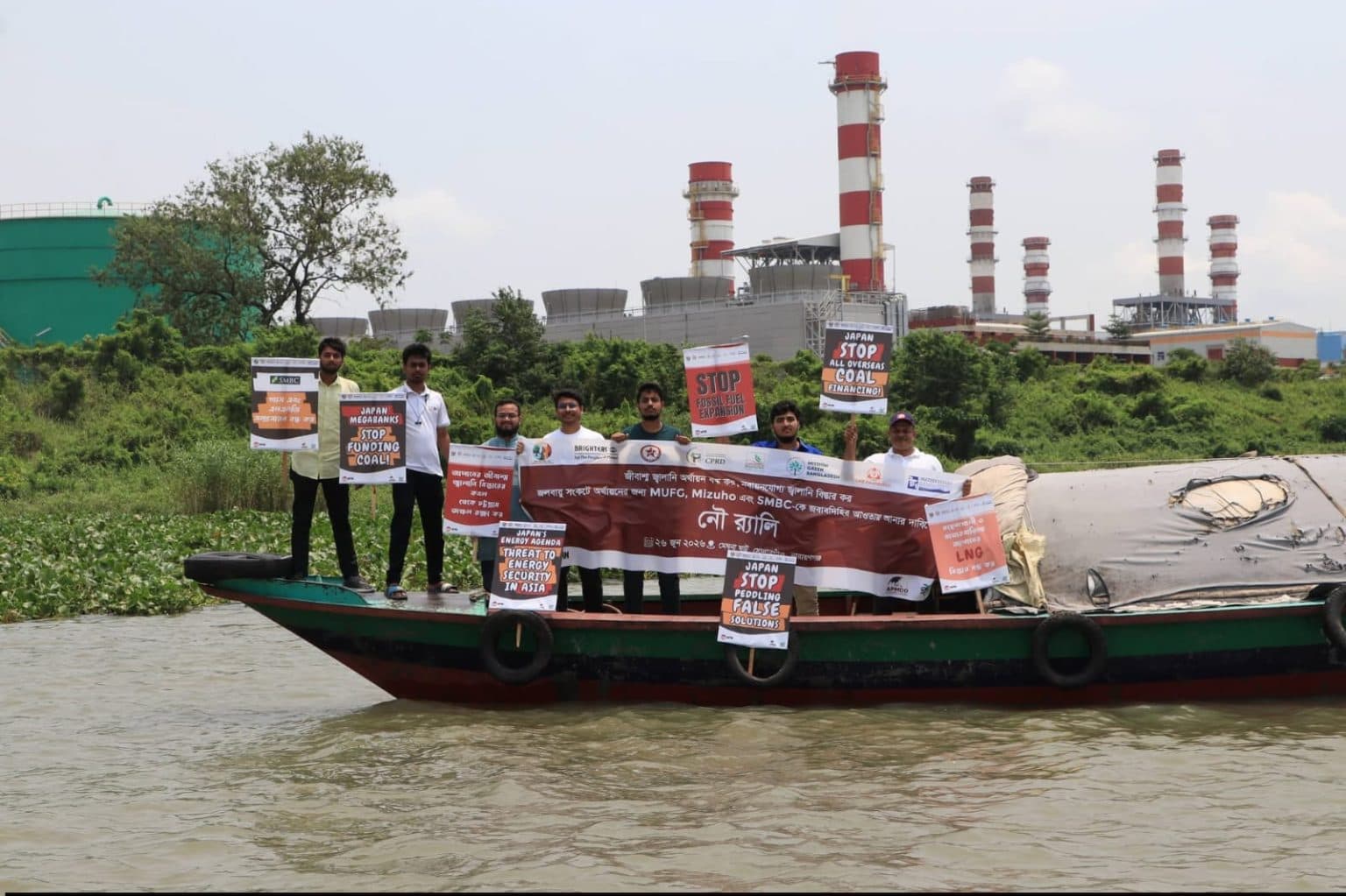
"On 26 June 2026, Bangladesh joined coordinated climate actions across Asia calling on Japan's three largest megabanks—Mitsubishi UFJ Financial Group (MUFG), Mizuho Financial Group, and Sumitomo Mitsui Banking Corporation (SMBC)—to end fossil fuel financing and increase investments in renewable energy. The demonstrations were organized as part of a regional campaign led by the Asian Peoples' Movement on Debt and Development (APMDD), with simultaneous actions taking place across several Asian countries."
On 26 June 2026, Bangladesh joined a coordinated wave of climate actions across Asia demanding that Japan's three largest megabanks—Mitsubishi UFJ Financial Group (MUFG), Mizuho Financial Group, and Sumitomo Mitsui Banking Corporation (SMBC)—end their financing of fossil fuel projects and increase investments in renewable energy.
The regional campaign was organized under the leadership of the Asian Peoples' Movement on Debt and Development (APMDD), with synchronized demonstrations taking place in Bangladesh, the Philippines, Indonesia, and several other Asian countries. The main protest was held in Makati City, Philippines, coinciding with the Annual General Meetings (AGMs) of the three Japanese megabanks.
In Bangladesh, the campaign was coordinated by Waterkeepers Bangladesh in collaboration with nine partner organizations. Three peaceful demonstrations were organized simultaneously across different regions of the country to highlight the environmental, social, and economic impacts of continued fossil fuel financing.
The nationwide actions included a boat rally at Meghnaghat in Sonargaon, Narayanganj, a bicycle rally in Matarbari, Cox's Bazar, and a human chain in Kodda, Gazipur. The events brought together environmental organizations, youth activists, students, fishers, farmers, local communities, researchers, and civil society representatives who united in calling for climate-responsible financial policies.
Participants highlighted that Bangladesh is one of the countries most vulnerable to the impacts of climate change despite contributing only a small share of global greenhouse gas emissions. They emphasized that continued investment in fossil fuel infrastructure increases climate risks, including stronger cyclones, devastating floods, coastal salinity intrusion, extreme heatwaves, and the loss of livelihoods for farming and fishing communities.
The campaign called on the Japanese megabanks to immediately stop financing new coal, oil, and gas projects and to establish a clear roadmap for phasing out investments in existing fossil fuel infrastructure. Participants also urged international financial institutions to significantly increase investments in renewable energy, community-led climate solutions, people-centered development, and a just and equitable energy transition.
The coordinated demonstrations across Asia delivered a strong message that financial institutions must align their investment decisions with global climate goals. By ending fossil fuel financing and prioritizing clean and renewable energy, banks can play a critical role in reducing greenhouse gas emissions, strengthening climate resilience, and supporting sustainable development.
Bangladesh's participation in the regional campaign reflected the country's growing commitment to climate justice, responsible finance, renewable energy, and a just transition toward a cleaner and more sustainable future for present and future generations.