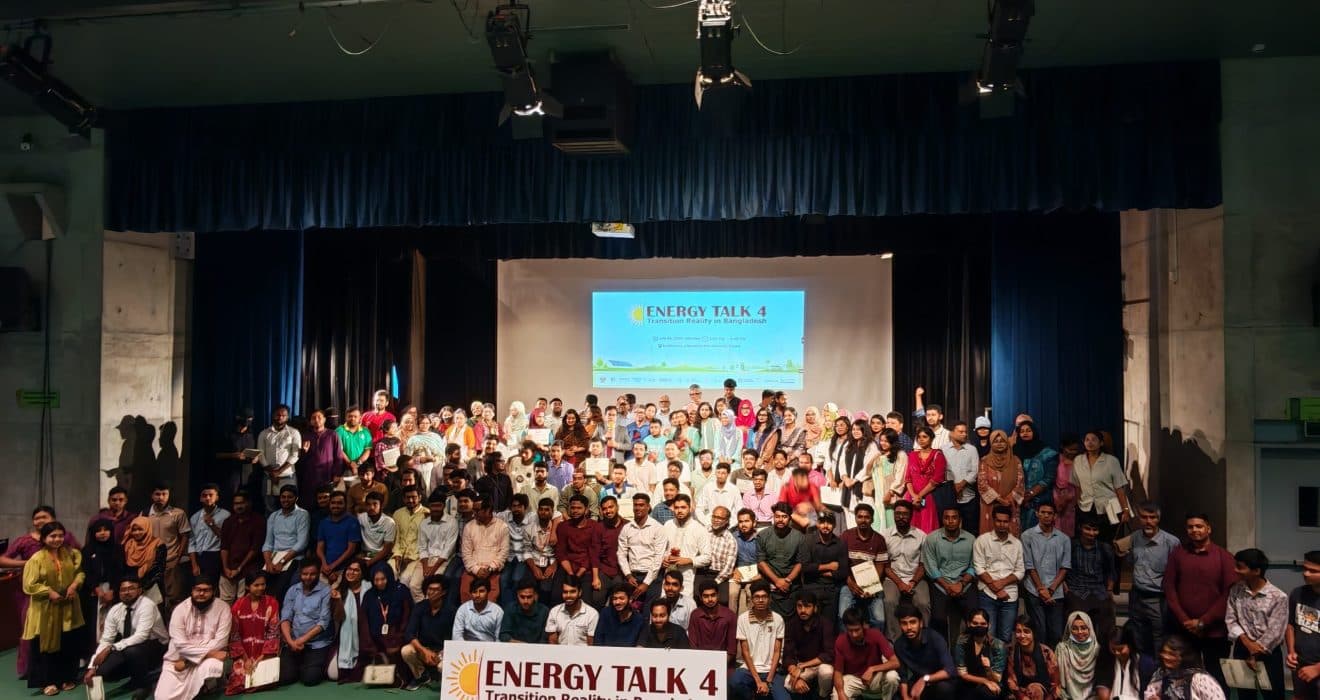
"With the aim of promoting a just, sustainable, and renewable energy-based future for Bangladesh, "Energy Talk-4: Transition Reality in Bangladesh" was organized at the auditorium of the Liberation War Museum in Dhaka. The event, organized by **Waterkeepers Bangladesh** and **Dhoritri Rokkhay Amra (DHORA)**, brought together leading energy experts, researchers, academics, environmental advocates, youth leaders, and civil society representatives to discuss Bangladesh's current energy landscape, renewable energy opportunities, international trade and policy implications, and the role of public engagement in advancing a just energy transition."
With the objective of advancing a just, sustainable, and renewable energy-based future for Bangladesh, "Energy Talk-4: Transition Reality in Bangladesh" was held at the auditorium of the Liberation War Museum in Dhaka. The programme was organized by Waterkeepers Bangladesh and Dhoritri Rokkhay Amra (DHORA) and moderated by Dr. Mir Mohammad Ali, President of the Dream Research and Development Foundation (DRDF) and Assistant Professor at **Sher-e-Bangla Agricultural University**.
The dialogue brought together leading energy experts, researchers, academics, environmental activists, development practitioners, university students, youth leaders, and representatives of partner organizations to examine Bangladesh's evolving energy landscape, the prospects for renewable energy development, the implications of international trade and policy changes, and the role of civil society in ensuring a just and inclusive energy transition.
Speaking on **"The Rationale for Energy Transition in Bangladesh,"** **Shafiqul Alam**, Lead Energy Analyst at the **Institute for Energy Economics and Financial Analysis (IEEFA)**, stated that Bangladesh's energy crisis is driven not only by supply shortages but also by the increasing risks associated with dependence on imported fuels. He emphasized that expanding renewable energy, improving energy efficiency, and maximizing the use of domestic resources represent the most effective pathway toward a sustainable and resilient energy future. He further noted that the current period offers a critical opportunity for Bangladesh to accelerate its transition to clean energy.
Presenting on **"The Potential Impact of Agreement on Reciprocal Trade on Energy Transition,"** **Dr. Moshahida Sultana**, Associate Professor at the **University of Dhaka** and an energy researcher, observed that energy policy extends far beyond technology and economics. She explained that it is deeply connected with international trade, geopolitics, and national interests, emphasizing that any future trade agreements should strengthen Bangladesh's long-term energy security while supporting the country's transition toward renewable energy.
Addressing **"The Energy Transition Movement,"** **Sharif Jamil**, Coordinator of **Waterkeepers Bangladesh** and Member Secretary of **Dhoritri Rokkhay Amra (DHORA)**, stated that energy transition is no longer an aspiration but an urgent necessity for Bangladesh. He highlighted the importance of collective action to reduce dependence on fossil fuels, minimize pollution and climate risks, and promote a renewable energy-based, equitable, and sustainable future. He further stressed that development initiatives which destroy ecosystems, harm public health, or threaten people's livelihoods cannot be regarded as sustainable development. According to him, Bangladesh's energy transition movement must pursue a clean, just, and equitable shift toward renewable energy and should be embraced as a shared national commitment rather than the agenda of any single organization.
Each presentation was followed by an interactive question-and-answer session and open discussion, allowing participants to exchange ideas on policy priorities and implementation challenges. Speakers collectively emphasized the need to expand renewable energy deployment, introduce effective policy reforms, strengthen research and innovation, facilitate technology transfer, and increase public participation to build a transparent, environmentally sustainable, climate-resilient, and inclusive energy sector in Bangladesh.
The programme concluded with the organizers reaffirming their commitment to continuing the **Energy Talk** series as a platform for strengthening public awareness, promoting evidence-based research, encouraging policy dialogue, and increasing meaningful youth engagement in shaping Bangladesh's just and sustainable clean energy future.